“The Greatness of America”? Diversity and free speech

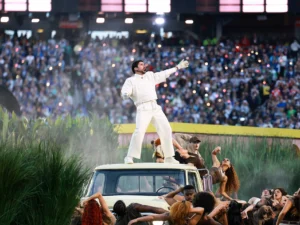
Bad Bunny performing

The football game on Sunday (Superbowl) was not much, a defensive battle mostly. But the half-time show was something, Puerto-Rican star Bad Bunny performing in a highly choregraphed rendition of some of his most popular songs, all sung in Spanish. The backdrop to the music was mostly scenes celebrating the culture of Puerto Rico. The opening scene featured sugarcane fields, highlighting the island’s agriculture and colonial history. From there, other aspects of life in Puerto Rico shown included a “La Casita” (typical home), a nail salon, a coconut stand, and men playing dominoes. The overall impression was the Bad Bunny was showing his pride and joy in being Puerto-Rican. He ended with “God bless America” (in English).

Not everyone was impressed with the performance. President Trump commented that the performance was “an affront to the Greatness of America, and doesn’t represent our standards of Success, Creativity, or Excellence. Nobody understands a word this guy is saying…”. Yet millions of Americans understand Spanish. Spanish in fact is very much a part of US culture, historically and practically integrated into all aspects of everyday life in this country. The same is true by the way for African-American contributions to our country. And for other minorities. To my mind that diversity is what makes up “the Greatness of America”, not ignoring or belittling the richness that those and other cultures (and people who are not white) bring to our lives. Bad Bunny demonstrated that. We should embrace the spirit expressed by the official motto of the European Union “United in diversity” or as it says on US currency: E Pluribus Unum (out of many, one).

The President is also unhappy about US athletes competing in the Olympics who do not embrace his view of what America stands for. He called Olympic skier Hunter Hess a “real loser” on Sunday after the athlete expressed “mixed emotions representing the US right now…there’s obviously a lot going on that I’m not the biggest fan of and I think a lot of people aren’t.” Hess posted an apparent response to Trump on Instagram, writing that he loves his country. “There is so much that is great about America, but there are always things that could be better. One of the many things that makes this country so amazing is that we have the right and the freedom to point that out.”

That in fact should be celebrated as another aspect of the “the Greatness of America” that we can love this country and yet strive to make better by pointing out what needs to be changed. And be allowed to express that opinion.
Diversity is a strength, not a problem

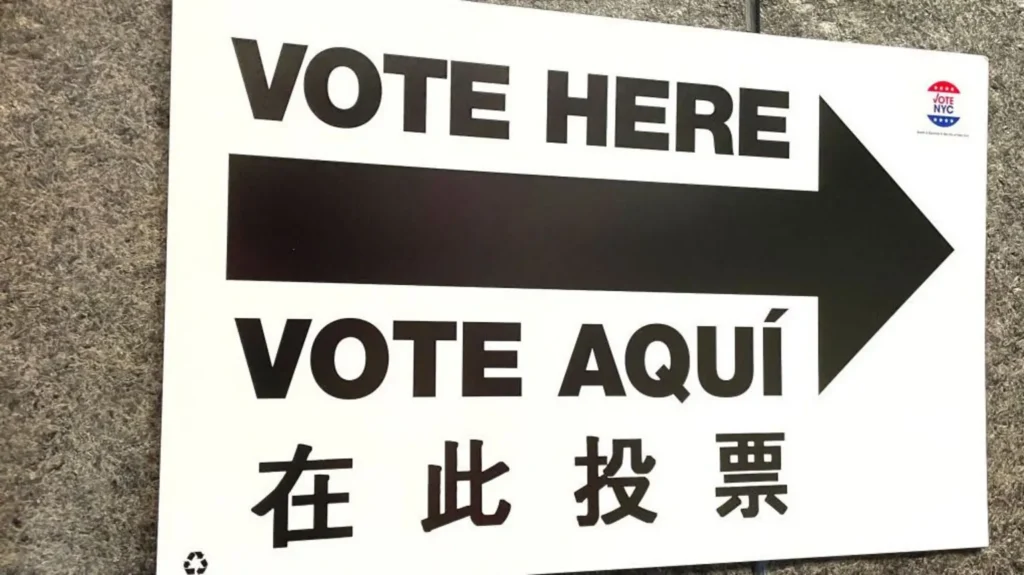
Multilingal voting sign: a thing of the past?

There is yet another executive order forthcoming from President Donald Trump, according to reports in the Wall Street Journal and Politico, this time proclaiming English as the official national language of the United States. It is not that there has been any doubt about what the dominant language of the country is of course, but it’s clear what the point of this order is: to alert those whose first language is not English that they are lesser-class US citizens. It is an invitation to discriminate against non-English speakers, with the additional outcome of instilling feelings of inferiority into families where English is not the primary language. It is likely to accelerate the decline in language learning in the US, which has already been underway for some time. The directive aligns with a growing move towards nationalism and xenophobia in the US, which unfortunately we are seeing in other countries as well.

The executive order joins others dismantling DEI (diversity, equity, inclusion) efforts in government agencies. That affects US universities as well, as they have been told to shut down DEI programs or be in danger of losing funding from federal agencies. This has repercussions on academic programs and on educational opportunities for disadvantaged populations (minority groups, LGBQ+ individuals, women, less abled individuals, and more). It also has led to programs and individual faculty members being told to eliminate terms that can be interpreted as pro-DEI from Web sites and other online documents. I’m waiting to see if I will be asked to take down some of the pages of the open textbook I wrote on intercultural communication, as many chapters deal with topics such as racism, intolerance, and white privilege.

In the textbook I also promote the value of learning another language, as it has been shown to increase tolerance and understanding towards other cultures. Being bilingual also opens up new worlds of experience, emotion, and personal growth while providing insight into how language mediates our interactions with others and with our own identity. There was a fascinating interview this week on NPR with Mexican writer, Cristina Rivera Garza, whose 2007 novel La muerte me da (Death Takes Me) was recently translated into English. In the interview, the author talks about writing alternatively in Spanish and in English. She says that for emotionally laden topics (like writing about her deceased sister) she finds turning to writing in English creates a “buffer” that allows her to write with an emotional detachment that she doesn’t have available when writing in Spanish. In that way, she says, having access to a second language “may provide you with opportunities and freedoms that the language that you grew up with could not afford”.

It’s a shame to see government policies that will lead to fewer opportunities for developing bilingualism, and through it the expanded personal experiences that kind of double self creates. Maintaining a diversity of languages in our society, as well as a diversity of lifestyles, beliefs, and behaviors, enriches all of our lives.

Colors and body parts

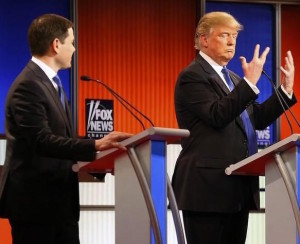
donald-trumps-hands-suck-1457116346-crop_desktopThis past week there have been some remarkable public comments on personal appearance and body builds. In the most recent Republican debate, “Little Marco” (Trump’s term) tangled with “Big Donald”, with Donald Trump commenting on Marco Rubio’s statements about his hands, clearly referencing his male prowess: “And, he [Rubio] referred to my hands — ‘if they’re small, something else must be small.’ I guarantee you there’s no problem. I guarantee.” This follows Rubio’s comments about Donald having wet pants in the breaks from an earlier debate. In a press conference, Trump commented on how much Rubio sweats: “Can you imagine,” Trump said of Rubio meeting Russian President Vladimir Putin, “and he walks in and he’s drenched. I have never seen a human being sweat like this man sweats. … It looked like he had just jumped into a swimming pool with his clothes on.” Speaking of Putin, there we clearly have a politician who feels that projecting a hyper-masculine persona is important for his image. He frequently is seen in press photos bare-chested, playing sports, or engaging in other activities that highlight his body build. His walk is best described as a swagger. It’s sad to see US politicians engaged in outdoing each other in terms of masculinity – the last thing that should determine who is best able to be President is the level of testosterone (or the ability to hurl insults).

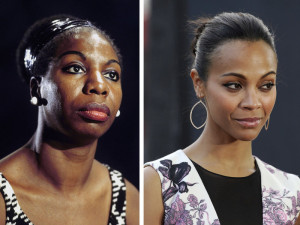
Nina Simone and actress Zoe Saldana

Nina Simone and actress Zoe Saldana

A controversy over skin color emerged in the last week in reference to the movie of the life of singer Nina Simone. This has brought out for public discussion the issue of colorism – the idea that skin tone (how light or dark) and not just race, can lead to prejudice and discrimination. The actress selected to portray Simone is Zoe Saldana, who is Latina, but self-identifies as black. Her parents are from Puerto Rico and the Dominican Republic, where, as elsewhere in Latin America and the Caribbean, there is a mix of ethnic and racial backgrounds which results in a broad range of skin tones. Saldana is light-skinned, in contrast to the dark-skinned Simone. This has been seen as one more example of “Hollywood’s attempt to sideline women with dark skin”. What makes the issue particularly troublesome is that for the movie Saldana wore black face, recalling past racist practices in the entertainment industry. Many have pointed out also that it’s not just a case of trying to cast someone that comes close to the appearance and background of the person portrayed, but that in this case Nina Simone famously made a point of talking and singing about her blackness, which she celebrated but which also resulted in missed opportunities, such as being refused entry to the Curtis Institute of Music.

Another issue of appearance arose in an interview this week-end on NPR with Joanna Hausmann, a Venezuelan comedian who makes videos for The Flama, focusing on Latino culture. Hausmann has a Jewish father, whose parents were Holocaust survivors, and a Cuban mother. She uses her personal background as one of the main sources of her comedy:

I think that I grew up explaining who I was, right? As a white Latina with a Jewish last name. That does not make sense in the conceptualization of what a Latina should be. Also I’m not particularly suave, I’m incredibly awkward. There’s something about my identity that does not mesh with what people think the identity should include. …

[Growing up] I was trained in explaining my identity in a way that wasn’t surface level. And it also opened me up in understanding that people can literally have absolutely any background and what we conceive to be their identity, or their reality or their background is usually not the case.

Hausmann celebrates not only the variety of appearances of Latin Americans, but also the variety of ways in which Spanish is spoken, as in the video below: