South Korea: A lookist society (not the only one)

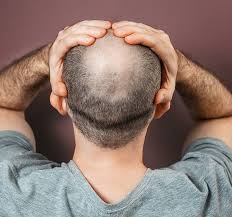
Oh no, I’m going bald!

Losing one’s hair can be something that changes our appearance, how others view and treat us, and likely how we see ourselves. While that may be a universal experience, a report recently on NPR public radio (also on BBC) about hair loss in Korea indicates that it is a much more significant occurrence there. The President of South Korea wants his country’s national health insurance program to cover hair loss treatment for its citizens. President Lee Jae Myung says this isn’t just a cosmetic issue: he has called it “a matter of survival.” How could that be? No one dies from hair loss, right?

According to Professor S. Heijin Lee (U. of Hawaii), interviewed in the NPR piece,

I think the important part to look at is that he characterizes hair loss as quote-unquote “a matter of survival. ” And this really references this idea that Korea is a very lookist society. That’s not a term that we use too much here in the U.S., but in Korea, it’s very commonplace.

The idea of a “lookist” culture is that looks really matter in that society. While one could argue that such a view is universal (good looking folks get privileged), the situation in South Korea is, according to Professor Lee, that discrimination against those not looking a certain way is allowed and implemented widely. She points to the fact that routinely photographs are included on resumes, so that, she says, “your looks are your credentials”.  Women in South Korea have long complained about that practice and also in general about how Korean society makes extra demands on women in terms of looks. Another reflection of that is the booming industry in Seoul for plastic surgery (centered in the Gangnam district).

Professor Lee claims that the South Korean President is not just looking out for the welfare of men (the ones usually losing their hair). She argues that it is in fact the government of the country that plays a role in shaping beauty expectations that make baldness a “a matter of survival.”  The government doesn’t really want to change the lookist character of Korean society, as “the government benefits from its popular culture industry, which is a purveyor of these beauty standards…K-beauty is, you know, a multibillion-dollar industry.”

K-beauty is the umbrella term for skincare and beauty products, which is a gigantic industry in South Korea. Those products are exported worldwide. Professor Lee points out that it is interesting that the President is not proposing to change any of those areas, “but what he is proposing to do is to cover a very small fragment of a solution”. Of course, beauty products are not alone in terms of popular culture exports from South Korea. K-pop has been a global phenomenon for some times. The tremendously popular movie, KPop Demon Hunters, is a reflection of that.
Changes in M.L. King Holiday signal shifts on US history

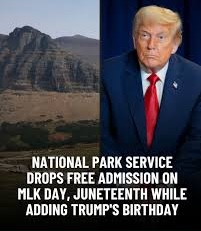
Today in the US is a national holiday, Martin Luther King Jr. Day. This year it’s a bit different from the past. One change is the entrance to national parks is no longer free today, as it has been in the past, which is true for Juneteenth as well (June 19th). Through an Executive Order, free entrance instead will be on two other days, Presidents’ Day and Flag Day (happens to also be President Trump’s birthday). That aligns with other changes in official federal perspectives on the role of African Americans in US history since President Trump has been back in the White House, one year ago tomorrow (January 20, 2025). Museums such as the Smithsonian and federally controlled websites have changed information about civil rights struggles and the lives of slaves, minimalizing accounts of conflicts and struggles for equality, formulated as “removing race-centered ideology”.

That reflects changes in how US history is being taught in many parts of the country, with the explanation that historical accounts of this country’s development should celebrate its glories and triumphs (the Declaration of Independence or victory in WW II, for example), contributing to boosting patriotism and promoting national unity, and play down divisive events and the negative interpretations of historical events (slavery, for example). Showing the reality of past events, including the ugly aspects, the argument goes, might upset people and cause white citizens to have feelings of guilt.

That view is echoed in a statement from Vice President Vance that “In the United States of America, you don’t have to apologize for being White anymore.” The administration was worked to enforce that perspective, eliminating programs that promote DEI (diversity, equity, inclusion), with the justification that their purpose and outcome was not to provide restorative justice and help bring equal opportunities to groups historically discriminated against (black and brown people, women, LGBT+ folks) but rather to disadvantage white people and make them feel they were responsible for past injustices. In preparation for today’s holiday, the President in an interview with the New York Times expressed that opinion in relation to the civil rights movement of the 1950’s and 1960’s, stating that the result of that movement was that white people “were very badly treated.” The emphasis from the White House is entirely on the wrongs Whites have suffered. That point of view dismisses White Privilege as a myth.

Another view of US history might be that the civil rights movement should be a source of pride for all Americans, as it shows that when injustice becomes evident, the US has found remedies. That could apply to other cases where abuse or conflict has resulted in positive change. One example that comes to mind are the dramatic changes in the powers of the presidency put into place after the abuses of President Nixon exposed through the Watergate Affair (now unfortunately no longer in effect).

Dr. King in his most famous speech hoped that in the US people would not be judged according to the color of their skin, but by the “content of their character”. Unfortunately, today we see that people are being judged by the color of their skin, their religion, their gender, their ethnicity. An article today in USA Today (not a beacon of progressive politics) points to how Somali Americans in Minneapolis have been stigmatized as a group due to alleged fraud by members of that community. The author comments: “A crime committed by Irish American bar owners in Boston wouldn’t lead to persecution of Irish American tavern owners in Ohio”, implying that in fact White Privilege is alive and well in this country.

When a peace sign has a very different meaning

Maduro gesturing after his arrest

There was a story this week in the New York Times that illustrates the different cultural meanings of gestures, in this case, the V-sign (made with two fingers) seen as the peace or victory sign in the US depending on the way the hand is positioned. The story dealt with the “perp walk” of Venezuelan President Nicolás Maduro captured by US special forces in a raid on Caracas this weekend. As Maduro and his wife were led off in handcuffs, he flashed the thumbs up sign (a likely gesture of defiance) and then the V-sign with his other hand used to point towards it. According to the article, the meaning was quite specific and had nothing to do with peace:

The two-handed symbol used by Mr. Maduro — one hand forming a “V,” the other pointing toward it — means, “Nosotros venceremos,” or “Together we will win,” according to experts on Chavismo, the political movement named for Hugo Chávez, Mr. Maduro’s predecessor. It is a phrase that has long been used by leftist revolutionary movements in Latin America, including Cuba’s, to signal the triumph over oppression.

The true meaning of the gesture was clear to Venezuelans: “On social media, the repeated gesture quickly spread, with some claiming that it visually resembled Mr. Chavez’s signature, which after his death in 2013 became a ubiquitous symbol, including in tattoos.” Also at a session of Venezuela’s National Assembly in Caracas on Monday, legislators flashed the same sign, as did Jorge Rodríguez, who at that session was ratified as president of the National Assembly. He is the brother of Delcy Rodríguez, the former Vice President who on Sunday was sworn in as the country’s interim leader.

After being sworn in as Assembly president, Jorge Rodríguez reaffirmed his loyalty to the ousted Maduro in nonverbal form:

When those in the room — and the cameras — turned toward Mr. Rodríguez, he first raised a fist in the air, then made the same “V” gesture Mr. Maduro had, along with a thumbs up. The sequence appeared to be a homage to, or a call and response, with Mr. Maduro, who was by then about 2,000 miles away… Supporters celebrated the moment and Venezuela’s main state-run television outlet, VTV, called Mr. Maduro’s gesture a “potent symbol of dignity and courage” and a “sign of peace and victory.”

The use of the hand gesture demonstrates how nonverbals can have very specific local meanings, quite different from the default. Another example is the “ok” sign, forming a circle by connecting the index finger to the thumb, with the other fingers spread out. In some communities, especially online, that gesture has become associated with white supremacy and the far right (outstretched fingers as “W”, the circle and hand as “P”, for “White Power”).

The intense reaction in Venezuela to Maduro’s gesture also demonstrates the potential power of nonverbals, a useful device in situations where verbal speech is not possible, as was the case for the incarcerated Maduro. That is something we see often in sports, where also verbal messages are not effectively conveyed, as in goal celebrations in soccer or in (American) footfall. Nonverbals in those circumstances can be much more effective communicative devices.