Multilingual South Africa

SOUTHAFRICA_SS1I am in my last day in Johannesburg, South Africa, having attended a linguistics conference here for the past week. It’s been a fascinating experience, both attending presentations at the conference and experiencing South Africa for the first time. The language situation in South Africa is complex. There are 11 official languages (versus just 2 in the Apartheid days, English and Afrikaans – derived from Dutch). The fascinating fact for me is that virtually everyone here speaks English, but it is rare that it is anyone’s native tongue. Most likely it is the second language (for white Afrikaans speakers) or the second or third language (for black South Africans). Many South Africans speak more then two languages, especially Blacks, who often speak their home language (such as Xhosa or Sotho) and also English and possibly also one or both of the other two languages which have a lingua franca function here, namely Afrikaans and Zulu. In one presentation today it was mentioned that adult Blacks do not necessarily view their native language as their best language – that might be English or Afrikaans, languages which are vital for success in higher education and in the professional world.

There was a presentation today by a Swiss linguist, who reported on language issues in health care in Switzerland. She started off by mentioning that her country also has multiple official languages (German, French, Italian, Romantsch). At the end of her talk there was a question from a South African in the audience, asking why, if Switzerland were multilingual like South Africa, there was any need for interpreters or other assistance in health care. She was assuming that the situation was analogous to multilingual South Africa, where it’s the norm to speak multiple languages, and, if possible, to learn to speak (although not necessarily to read or write) all the languages used widely in your region. The Swiss linguist was somewhat taken aback by the question and responded that while there are multiple official languages, they are not all spoken throughout the country but rather are limited to particular geographic regions. Many Swiss within those regions speak only their native tongue (and often school English).

Maybe the South Africans learn more languages because they’re more open and approachable. One South African linguist at the conference reported an anecdote of a woman in a township being asked why she was learning an additional African language (her 4th or 5th language) – she responded that it would be rude not to be able to speak to her new neighbor who spoke that language.

Carefully taught

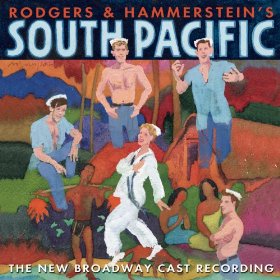
south_pacific“You’ve got to be carefully taught” is both a song title, from the 1949 Rodgers and Hammerstein musical South Pacific, and an entry in the Race Card Project. Having grown up partly in Hawaii, I have a special feeling for the musical, but had not thought much about the message of tolerance it contains until a story this morning on NPR on the song, suggested by multiple entries for the song title in the Race Card Project, which happens to have the same number of 6 words called for by the project. The song lyrics are surprising for the year in which they were composed:

You’ve got to be taught to hate and fear,
You’ve got to be taught from year to year,
It’s got to be drummed in your dear little ear,
You’ve got to be carefully taught.
You’ve got to be taught to be afraid
Of people whose eyes are oddly made,
And people whose skin is a diff’rent shade,
You’ve got to be carefully taught.
You’ve got to be taught before it’s too late,
Before you are six or seven or eight,
To hate all the people your relatives hate,
You’ve got to be carefully taught!

The message is clear: prejudice is not something you are born with, but is culturally conditioned. It’s so sad to see children spouting racist or homophobic slogans, as those early learned views are so hard to lose.

Check your privilege

Screen Shot 2014-05-16 at 9.13.12 PM

Tal Fortgang on Fox News

There has been a lot in the news recently about white privilege, following the case of Princeton University freshman Tal Fortgang. He reacted to the comment by a classmate that he should “check his privilege” by writing a piece published in Time Magazine. He rejects the idea that there is any kind of white privilege in American society and that he is any way someone who has enjoyed advantages from growing up white and male in a well-to-do upper middle class family. He points to the difficulties in his family history, including his grandparents fleeing the Nazis and immigrating penniless to the U.S.:

Behind every success, large or small, there is a story, and it isn’t always told by sex or skin color. My appearance certainly doesn’t tell the whole story, and to assume that it does and that I should apologize for it is insulting. While I haven’t done everything for myself up to this point in my life, someone sacrificed themselves so that I can lead a better life. But that is a legacy I am proud of.

Fortgang certainly has a point, that who you are is not determined by your gender or your racial identity. We all create our persona from multiple sources and influences, including, as Fortgang emphasizes in the story of his hard-working father, through industry and personal fortitude. But he implies that we all have the same starting point for being successful in US society, which I and many others would argue is not the case. The case for that was made by Peggy McIntosh, a women’s-studies scholar at Wellesley College, in a widely read essay entitled “White Privilege: Unpacking the Invisible Backpack” in which she provides an extensive list of examples, starting out with these:

1. I can if I wish arrange to be in the company of people of my race most of the time.
2. If I should need to move, I can be pretty sure of renting or purchasing housing in an area which I can afford and in which I would want to live.
3. I can be pretty sure that my neighbors in such a location will be neutral or pleasant to me.
4. I can go shopping alone most of the time, pretty well assured that I will not be followed or harassed.
5. I can turn on the television or open to the front page of the paper and see people of my race widely represented.
6. When I am told about our national heritage or about “civilization,” I am shown that people of my color made it what it is.

Interestingly, McIntosh was interviewed a few days ago for a piece in the New Yorker on “The Origins of ‘Privilege’” and commented on the Fortgang controversy:

When Tal Fortgang was told, “Check your privilege”—which is a flip, get-with-it kind of statement—it infuriated him, because he didn’t want to see himself systematically. But what I believe is that everybody has a combination of unearned advantage and unearned disadvantage in life. Whiteness is just one of the many variables that one can look at, starting with, for example, one’s place in the birth order, or your body type, or your athletic abilities, or your relationship to written and spoken words, or your parents’ places of origin, or your parents’ relationship to education and to English, or what is projected onto your religious or ethnic background. We’re all put ahead and behind by the circumstances of our birth. We all have a combination of both. And it changes minute by minute, depending on where we are, who we’re seeing, or what we’re required to do.

McIntosh accepts Fortgang’s that the whole story “isn’t always told by sex or skin color”, but that there are many more factors at play. I was at a conference presentation recently in which the main topic was how to include diversity as a topic in online courses. The first question after the presentation was by the only African-American in the audience. I expected, as did probably the rest of the folks there, for her to comment on diversity from the perspective of growing up black in the US. Instead, she went on at considerable length about what it was like to grow up skinny and suggested that body size be included in discussing diversity and discrimination.

On the lighter side, Buzzfeed has an interactive checklist for seeing how privileged you are. For an alternative view on white privilege, here is Louis CK’s take on being white:

Best way to learn a language?

rosetta_stone_tcg._V360836561_I’m just returning from the annual CALICO Conference (Computer-aided language instructional consortium) where I gave a presentation on the creation and use of e-books in language learning. The most interesting presentation I attended was a study on the use of Rosetta Stone in learning Spanish at the elementary level. The session, “Online and Massive, but NOT the Future of Language Learning: Further Evidence in the Case Against Rosetta Stone” by Gillian Lord of the University of Florida, presented the findings from a study in which the results of three different groups of beginning Spanish were compared. One group used Rosetta Stone exclusively, the second used the software but also had some class meetings, and the third was a traditional face-to-face class. Lord has not yet completed the analysis of data from the study, and the sample size in the study was small, but the preliminary findings are revealing. In some areas, student outcomes were comparable, particularly in the area of vocabulary acquisition. Where the outcomes differed significantly is in the area most touted in Rosetta Stone’s massive marketing, namely the ability to conduct a conversation in the target language. Lord showed transcripts of the conversations in Spanish she had with students from each of the groups several times during the semester. They showed that the students in the Rosetta Stone groups had acquired a good amount of vocabulary, and had gained some proficiency in listening comprehension, but had great difficulty in coming up with anything to say in Spanish, often using English in place of Spanish. They were particularly weak in the area of strategic competence in Spanish, that is, the ability to express a lack of understanding, to ask for assistance, or to find work-arounds for missing vocabulary or structures. Using language requires the ability to go beyond learned words and phrases, to be able to negotiate meaning with your conversation partner, through asking for help or re-stating in another way what you meant to say. Rosetta Stone’s software does not provide practice in that area.

Lord’s study did not address what I find to be an additional shortcoming in Rosetta Stone – the lack of cultural context. I experienced this myself several years ago when I was taking courses in both intermediate Russian and intermediate Chinese. As part of the Russian course, we were assigned to use Rosetta Stone in our language lab. I was curious how the program differed from language to language, so I also used the Chinese version, at the same proficiency level. I was surprised to find that the images, situations, sentences, and even vocabulary were exactly the same in the two languages. Language in Rosetta Stone is decontextualized, disembodied from the culture it represents. This not only provides little insight into the target culture, it also suggests that language can be divorced from culture and that learning a language is a simple process of substituting words and phrases in the target language for those in your mother tongue. No need to adjust culturally. This may, in fact, be the key to Rosetta Stone’s popularity: it takes away the messy complexity of language learning. The linear approach, along with the feel-good positive feedback the program provides, as you progress from level to level, gives users the impression that they are indeed becoming proficient in the language. In fact, in this way the Rosetta Stone ad I just read in my in-flight magazine is right on target: “The success you feel when you learn the Rosetta Stone way can change the way you feel about yourself”. That’s a much more accurate statement about the program than the company’s tag line: “Language learning that works”. Anyone having struggled to become proficient in a second language has experienced personally that language learning is not the simple, linear process suggested by Rosetta Stone’s approach and marketing, but rather more of a lurching experience, with lots of frustration, punctuated by occasional triumphs.  The image that calls to mind is not a straight line, but at best a spiral, in which we go round and round, re-learning and perfecting material already encountered.

Little Red Ridinghood & Evolutionary Biology

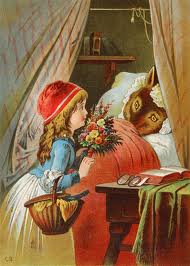
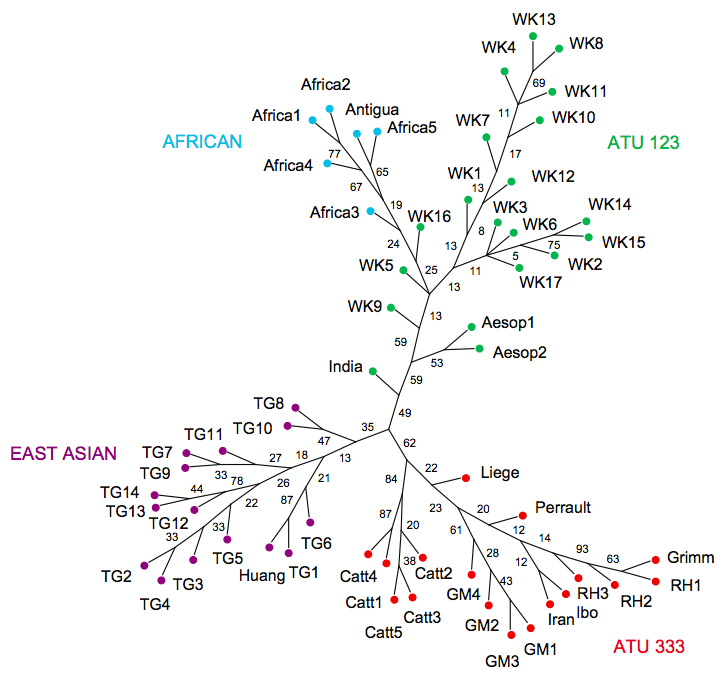
rotThrough a note in the current issue of The Smithsonian, I was alerted to an article I missed when published last fall in the open access journal Plos One. “The Phylogeny of Little Red Riding Hood” by Jamshid Tehrani examines the origins of the well-known story, likely most familiar from the Grimm Brothers version, “Rotkäppchen”, first published in 1812 in their Kinder- und Hausmärchen. Folklore scholars have long been interested in tracing the origins of folk tales, their evolution over time, and their geographical distribution. Traditionally, this has been done through a historical-geographic methodology, best represented by the Aarne-Uther-Thompson (ATU) index, which identifies more than two thousand international types distributed across three hundred cultures worldwide. Tehrani’s approach is quite different, borrowing techniques and tools from evolutionary biology. The article details his use of phylogenetic analysis, using cladistics, Bayesian inference and NeighborNet. These methods employ a branching model of evolution that clusters characteristics on the basis of shared derived (i.e., evolutionarily novel) traits. The NeighborNet tree is shown below.

map3

Tehrani analyzed 58 written versions of the story taken from a variety of countries over 2000 years, comparing 72 different plot points and resulting in a family tree showing the most likely relationships. One of the main findings is that, contrary to some theories, the story most likely did not originate in China (it’s not at the base of the tree), despite similar versions of the story recorded there. Unfortunately, he was able to use only tales that had been translated into English.

The sophisticated data analysis used here is not surprising when dealing with scientific topics, but may seem unusual when applied to fairy tales. However, such techniques have been used recently in other areas, including languages and manuscript traditions. In linguistics, the best-known case may be its use in mapping the origins and spread of Indo-European. Tehranie wrote about his research in The Atlantic, explaining in layman’s terms his approach. He concludes by expanding the value of his work beyond insights into origins and varieties of folk tales:

Folktales, more than any other type of story, embody our shared fantasies, fears and experiences. Understanding which elements of them remain stable and which ones change as they get transmitted across generations and societies can therefore provide a unique window into universal and variable aspects of the human condition. As such, they represent a potentially rich point of contact between anthropologists, folklorists, literary scholars, biologists and cognitive scientists.

The Other Language

Francesca Marciano, the author of the collection "The Other Language." Credit

Francesca Marciano, the author of ‘The Other Language’

Interesting piece this week-end in the NY Times about authors writing in adopted languages, such as Francesca Marciano, the author of a collection of short stories, he Other Language. It’s hard enough to be a writer in your native tongue, but imagine writing publishable stories in a second language. Creative writing is quite different from conveying information – that’s something that can be done, even if grammar is faulty and word choice seems strange. To write well necessitates having a “feel” for the language, including the use of idiomatic expressions and of valid collocations – those chunks of languages that go together. Native speakers have internalized this kind of pragmatic language use through extensive exposure to the language over time. It’s much harder for non-native speakers to capture believably the tone and nuance of a language, including hitting the right registers – for example, what level of informality or slang to use. It’s notoriously difficult, for instance, to use profanity correctly in a foreign language. The popular view of language learning is that it involves learning new words and new rules, but anyone who has tried to function in another language/culture has experienced the reality that such knowledge is necessary but insufficient. Speaking rather than writing provides some help in the form of non-verbals – facial expressions, tone, etc. – but in writing it’s just you and the blank page.

There are famous examples of writers of English who have not grown up speaking the language, Joseph Conrad or Vladimir Nabokov (although he learned English and other languages at a young age). What’s remarkable about those two writers, is the fact that they are know as great stylists, writing in a learned language. In fact, non-native speakers (like non-native language teachers) have a critical perspective on the language that may offer new insights. The Times article quotes Chinese writer Yiyun Li, who has just published her third novel in English: “If you are a native speaker, things are automatic…For me, every time I say or write something, I have to go back and ask, ‘Is this what I want to say?’ ”. Non-native writers may feel freer to play and experiment with the new language, more so than when writing in their native language.

Writing Chinese made easy?

fire

Word group from Chineasy

There has been a lot of media buzz lately about Chineasy, a book and Chinese character learning method by ShaoLan Hsueh.  Her method was first publicized in a TED talk she gave in 2013 and recently published in Chineasy: The New Way to Read Chinese. As someone who has struggled for years to learn Chinese characters, I was intrigued.  It turns out that her method is not quite as revolutionary as she claims.  It boils down to associating an image with the character which both represents the meaning of the character and illustrates it graphically, so for 火 (huo, meaning fire) she shows the character engulfed in fire, or for 山 (shan, meaning mountain), a picture of a mountain superimposed on the character. In most cases, she uses the historical origin of the character for her mnemonic.  She then shows how characters combine to make new words, as in volcano, “fire mountain”  (火山). She is by no means the first to advocate using such a method.  Many learners of Chinese are familiar with Rick Harbaugh’s Chinese Characters: A Genealogy and Dictionary, either the book or the web site, which presents a series of zipu or “character genealogies” which show graphically the close interconnections between over 4000 characters according to the  2000 year-old Shuowen Jiezi by Xu Shen and subsequent research by traditional etymologists. Another resource that explores graphically the origins of characters and associates them with images or little stories is the very well done Tuttle Learning Chinese Characters by Alison and Laurence Mathews.

What distinguishes Chineasy is above all the very nice color illustrations by Noma Bar.  Characters are grouped together based on the principal character used (such as a variety of combinations using the fire character).  The characters, however, are chosen not based on their use frequency, but based on whether they combine with other characters for which Noma Bar has found an appropriate illustration.  This makes for entertaining browsing through the book, but maybe not for practical vocabulary learning. Another caveat is that the characters used are the traditional character set, used in Taiwan and Hong Kong, but not in mainland China, which uses the simplified character set. This in fact makes it much easier to find appropriate illustrations, as the traditional characters reflect more accurately the origins of the characters.

Chineasy is not the first method to advocate learning characters first, before learning how to speak.  This was most notably championed by James Heisig in his series of books on Japanese and Chinese, starting with Remembering the Kanji.   This is not an approach widely used today.  In fact the all-oral approach of the popular ChinesePod podcasts assumes learners will probably not be interested in learning characters, or will do so later, after learning to speak.  At any rate, I would agree with the comments by Victor Mair on the LanguageLog blog, that the statement by ShaoLan Hsueh in her TED talk that learning to write Chinese is much easier than learning to speak to be very different from my experience and, I would venture to say, from that of the majority of Chinese learners.  However, given the difficulty of learning Chinese characters, I welcome any new thinking about approaches to keeping those pesky characters to stick in my brain. And the illustrations by Noma Bar are indeed very nice.

Code-switching Arabic in song

Yasmine Hamdan

Yasmine Hamdan

Interesting review today on NPR of the latest album from Lebanese singer, Yasmine Hamdan, Ya Nass. She is well-known in the Middle East, going back to her days in Soapkills, the duo she founded with Zeid Hamdan. Hamdan now lives in Paris and is fluent in English, French, and Arabic. However, she sings exclusively in Arabic. This is a decision that is culturally understandable, but which tends to limit her popularity. According to the BBC, Hamdan was offered a lucrative contract by music executives, if she were willing to sing in English, but she refused. She’s forgoing catering to the larger English-speaking public, at least in part, because her songs are culturally and linguistically tied to the Middle East. As she has traveled and lived in a variety of Middle-Eastern countries, Hamden speaks a variety of dialects of Arabic, which, according to Wikipedia, has enabled her “to playfully use various dialects of Arabic in her lyrics, which alternate between Lebanese, Kuwaiti, Palestinian, Egyptian and Bedouin, as well as some of the code-switching which is so typical of Middle-Eastern humour”. Clearly, English or French would have a whole different dynamic in her songs, losing much in the translation.

Code-switching among Arabic speakers is common, but that occurs principally between speakers’ own dialect of Arabic and Standard Arabic. Typically, Standard Arabic is used in formal, religious, and literary contexts, while dialectal versions are used in everyday situations. Code-switching can be used for paralanguage purposes, i.e. to convey irony, disdain, or special emphasis. It also has social functions, such as its use for identity negotiation, social-group membership, or to signal social solidarity (or superiority). Less common than the back and forth between Standard Arabic and dialect, at least in normal everyday situations, is the kind of dialectal code-switching done by Hamdan. However, it is used for effect in the entertainment industry. Such code-switching occurs in the U.S. entertainment as well, for example, by having a character speak with a strong hillbilly-like accent, a clear signal of unsophistication and a source of humor.

Yasmine Hamdan – Ya Nass ياسمين حمدان – يا ناس‬

U.S. Diplomat speaks Pidgin

U.S. Ambassador to Nigeria James Entwhistle

U.S. Ambassador to Nigeria James Entwhistle being interviewed

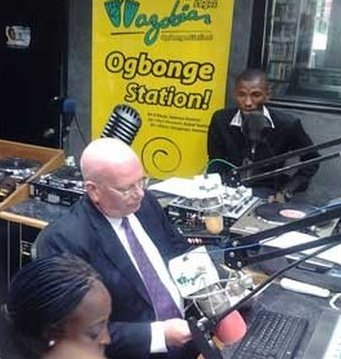
It’s not what you expect from the U.S. Diplomatic Corps, an ambassador who gives an interview in which he speaks what sometimes is described as “broken English”.  This was Ambassador to Nigeria James F. Entwistle speaking in an interview on Nigerian radio.  What he spoke (only in short segments) was pidgin English, a broadly spoken version of the language used across West Africa.  Entwhistle was interviewed on Nigeria’s Wazobia FM, the first radio station in Nigeria to broadcast in pidgin English.  When asked about Nigeria’s controversial anti-gay legislation, he responded:

“The U.S. government no say sanction go dey for Nigeria, because of same-sex palava-o.”

In other words, the U.S. is not going to impose sanctions on Nigeria for passing the  law.  When Entwhistle was asked about the U.S. position on the upcoming election in Nigeria, he asserted U.S. neutrality in these terms:

“Make I tell you say U.S. no get any candidate for mind. The only ting wey go sweet us be say make the election dey transparent, credible and concluded. Make Nigerians pick candidates wey go sweet their belle, wey go do well well for them.”

The Ambassador’s use of pidgin was much appreciated at the radio station and presumably by everyday Nigerians as well.  Even if they may not have agreed with his positions, they certainly liked to hear the ambassador of a major power speak their language.  As can be seen from the examples above, Nigerian Pidgin is quite distinct from standard English, in vocabulary, pronunciation, and grammar. The Pidgin English School offers video lessons in the language. It is certainly to the Ambassador’s credit that he has made the effort to be able to understand Nigerian Pidgin and speak it somewhat as well.

YouTube video of interview:

I, too, am Harvard

harvard2An article over the week-end in the NY Times discussed racial “microaggressions”, an increasingly used term on U.S. college campuses to describe “the subtle ways that racial, ethnic, gender and other stereotypes can play out painfully in an increasingly diverse culture”.  The Times cites examples: “A tone-deaf inquiry into an Asian-American’s ethnic origin. Cringe-inducing praise for how articulate a black student is. An unwanted conversation about a Latino’s ability to speak English without an accent.” These are clearly not examples of full-blown racism, but are indicators of a lack of awareness and sensitivity.  At a number of universities currently there are discussions of microagressions, through Facebook pages, photo projects, or blogs. There is debate in these forums as to whether the examples given are legitimate reasons to feel slighted or whether, as the Times states, they represent “a new form of divisive hypersensitivity, in which casual remarks are blown out of proportion.” The term’s prominence comes in part from the popularity of a blog begun by two Columbia University studens, the Microagressions Project.

At Harvard, a photo project called, “I, too, am Harvard” explores microaggressions experienced by black students at the elite university.  Many cite references to the appearance, often centered around hair, or casual statements about it being nice to be black when applying to Harvard.  That latter comment reflects one likely origin of such comments, the perceived experience of minority students receiving preferential treatment through affirmative action programs.  The photo project at Harvard has since morphed into a play.

An interesting take on such slights comes from Nigerian novelist, Chimamanda Ngozi Adichie. In a recent interview on NPR, Adichie recounts the bafflement she felt when a black fellow student at Princeton took offense at a classmate talking about watermelon.  As an African, she has had to learn the cultural dimensions of being black in the U.S.  Interestingly, she has a lot to say in the interview about hair and the importance of how Nigerian women chose their hair styles, a topic that also comes up in her wonderful novel, Americanah.

Becoming “Clark Rockefeller”

Christian Gerhartsresiter, aka Clark Rockefeller

Christian Gerhartsresiter, aka Clark Rockefeller

An interview this week on NPR’s Fresh Air brought back to light the case of “Clark Rockefeller”, the con man who was in reality Christian Gerharstreiter from Germany, not, as he claimed, a member of the Rockefeller clan.  That claim came after previous identities adopted over the years including being a British baronet, a cardiologist in Las Vegas, a Hollywood producer, and a bond broker in New York. The interview was with author Walter Kirn, who was a friend of “Rockefeller” for years.  Listening to the interview, it seems hardly credible that Kirn would accept the wild stories he was being told: that his friend was a “freelance central banker”, that he had never eaten in a restaurant, that he had attended Yale when he was 14, that he had a master key to the Rockefeller Center, that on successive week-ends he had as house guests Brittany Spears and then Angelika Merkel. It turns out that Gerhartsreiter was not only a con man, but he had brutally murdered a man in California in the 1980’s, a crime for which he was convicted last year and resentenced to prison for 27 years to life.

How was the massive deception possible?  Gerhartsreiter was skilled in reading his conversation partner and accurately gauging what stories would be believable.  His verbal skills were impressive, given the fact that he was not a native speaker of English.  The family with whom he originally stayed on coming to the U.S. as an exchange student (which he fraudulently arranged himself) when he was 18 reported that he experimented with different accents.  Eventually, he settled, according to Kirn, on an accent that sounded like Katharine Hepburn’s cousin. But, probably even more important than his language ability, were Gerhartreiter’s non-verbal skills.  His bearing, dress, and general appearance seemed to confirm his identity.  He acted out his roles with confidence and great self-assurance.  His success calls to mind the TED talk by Amy Cuddy in which she discusses the importance of body language and the possibility of adjusting your posture and appearance to convince yourself and others of the identity you want to convey.

Gerhartsreiter’s case also for me brings to mind a concept in modern linguistics:  performativity, originally conceived by J.L Austin. The idea of “performance” is that communicative competence is not, as often conceived, a matter of mastering the whole grammar system of a language, but rather of being able to strategically choose what is needed in particular contexts.  In this way, according to Suresh Canagarajah, performance “gives primacy to acts of creative and strategic communication motivated by the enigmatic purposes of complex individuals.  It draws attention to playfulness, fabrication, strategic negotiations, situationally motivated shifts, multiple identities” (from the forward to Clemente/Higgins, Performing English with a post-colonial accent:  Ethnographic narratives from Mexico). Christian Gerhartsreiter was clearly a master of performance in a number of senses.

Making MOOCs truly open

sorry-we're-open-signMassive open online courses (MOOCs) have become a worldwide phenomenon, as  interested folks from anywhere in the world can participate. Some MOOCs attract huge numbers of students, many coming from countries where access to higher education may be difficult or not available at all.  In some cases, students completing a MOOC are able to earn a certificate of completion or mastery that can be professionally useful.  Others participate purely for personal growth.  Almost all MOOCs are taught in English, although increasingly we are seeing such courses originate outside the English-speaking world. One of the recent trends are hybrid offerings, which combine the content and course structure from MOOCs with instructor-led local courses.

There have been plenty of critics of MOOCs, with some pointing to the high drop-out rate and others to the impersonal nature of how the courses taught or the lack of interactivity.  Increasingly, the consortia or companies offering MOOCs, such as Coursera, Edx, or Udacity, are working towards more peer-to-peer networking and more interactivity through self and peer assessments and more frequent learning tasks. One area that continues to lag in terms of online pedagogy is the limited amount of student-content interactivity.  Content is typically presented through videos, with minimal interactions – usually in the form of pausing the video for true-false or multiple choice questions. The content presentation is separate from the online discussions, with few options for participants to interact with the presenter, although sometimes a small sub-section of the course can actively comment or raise questions. The other limited aspect of MOOC pedagogy is the use of commercial textbooks, often an integral part of the course.  Sometimes the texts are supplied at low cost, but they tend to be static learning materials and are not normally available outside the course structure. The “open” in MOOCs doesn’t usually extend to content.

Recently, however, there have been developments in the MOOC space which offer a more open content model. One of those is the consortium of universities, mostly from the UK, FutureLearn, which features the Open University, long a leader not only in distance learning, but also in sharing course content.  Along with founder MIT and a host of other universities, the Open University is a member of the OpenCourseware Consortium, which makes content available in standard exchange formats such as the IMS Common Cartridge.  Many developments in open content sharing are occurring outside the U.S. Recently, for example, an online university has been created, based in New Zealand, OERu, that features open educational resources (OER).  One of the big advantages of using open content is the ability to customize course content, assembling OERs from different sources into a course, or starting with a piece of open courseware, then editing it as needed. For this to be possible, content needs to be made available in standard formats.  Today that usually means using HTML5 and could include as well the packaging format for e-book readers, EPUB 3. I recently published a piece in Language Learning & Technology which discusses how that can do done with examples for language learning.

Philly sound: Dying out?

philly

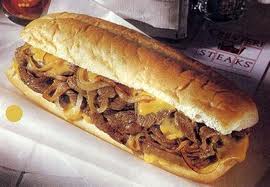
Philly cheesesteak: More popular than the accent?

Interesting article in the NY Times about what the author describes as “the most distinctive, and least imitable, accent in North America,” namely the “Philadelphia, or Filelfia, accent [which] may sound like mumbled Mandarin without the tonal shifts”.  What has been unique about the Philly sound was that it represented a mash-up of Northern and Southern accents: “Nowhere but in the Delaware Valley can you hear those rounded vowels — soda is sewda, house is hay-ouse — a clear influence from Baltimore and points south.”

Some examples of Philly talk from the article:

Jeet? D’jou wanna get a sawff pressle?  [Did you eat? Do you want to get a soft pretzel?]
Dry da wooder awf wit a tail.   [Dry the water off with a towel.]
’Lannic City’s too torsty anymore.  [
Atlantic City is too touristy these days.]

To hear the accent, check out the series of YouTube videos by Sean Monahan. Unfortunately, according to a recent study by linguists at the University of Pennsylvania, the accent is changing and moving towards greater similarity to other Northern accents.

Speaking of regional accents, a survey was conducted by cupid.com to determine the “sexist” North American accent.  The winner?  Southern.  The least sexy? “Mid-Atlantic” – does that mean Philly? On the other hand, the Philly Cheesesteak continues to find lots of admirers.

Facts: irrelevant!

just-the-factsHow hard is it to get people to change their beliefs? Really hard, even if facts are provided that refute those beliefs.  And even if those facts are accepted as true!  A recent study in Scientific American points to this conclusion. The study, by Brendan Nyham of Dartmouth College, dealt with the now-debunked idea that a vaccine for childhood diseases like measles causes autism.  The researchers were able to bring the parents who were vaccine-skeptics to the point that they believed the scientific research which showed no link existed.  However, they found surprisingly that after accepting the scientific evidence as fact, the parents indicated that they were even less likely to have their children vaccinated.   According to Nyham, “The first message of our study is that the messaging we use to promote childhood vaccines may not be effective, and in some cases may be counterproductive.” The explanation for this behavior is not completely clear, but Nyham speculates, based on previous studies, that the vaccine doubters likely recalled other objections or concerns: “We suggest that people are motivated to defend their more skeptical or less favorable attitudes towards vaccines.”  The takeaway:  changing people’s minds takes more than presenting facts, and may call for messages with a variety of arguments to counter misinformation and myths.

The recent debate about evolution between Bill Nye (the “science guy”) and Ken Ham of the Creation Museum may send an even more disturbing message.  It was widely acknowledged (including by Christian Today) that Bill Nye, basing his arguments on radiometric dating, the fossil record, and common sense, clearly won the debate.  Of course, whether the debate convinced evolution doubters to accept scientific evidence is uncertain.  What seems, however, to be an outcome of the debate is that it has led to a flood of contributions to a proposed theme park addition to Kentucky’s Creation Museum.  In fact, a number of scientists were leery of having such a debate, as it gives an aura of believability to creationism.  It’s a sad thought that just talking about such issues can be problematic and can reinforce mistaken ideas and beliefs.


Not in Putin’s plans: Crimean Tatars

tatar

Crimean Tatars in traditional dress

Part of the tense, complicated crisis currently in Crimea is the role of an ethnic group indigenous to the Black Sea peninsula, the Crimean Tatars.  Their history has made them side much more with Ukraine than with Russia in the current stand-off.  They were forcibly removed by Stalin from Crimea, which they consider their ancestral homeland, and in the waning days of the Soviet Union, under Gorbachev, gradually began returning to Crimea.  Today they represent some 12% of the population of Crimea. Having suffered persecution under both Czarist and communist Russia, the Crimean Tatars are understandably nervous about Crimea coming back under Russian control. In fact, until the recent arrival of Russian military units in Crimea, the Tatars were among the few groups outside Western Ukraine actively proclaiming their allegiance to the new Ukrainian government. According to a recent article in the New Republic, the Crimean Tatars are not likely to go along with an increasing Russification of the peninsula and may  cause trouble for Putin’s possible plans to annex Crimea.

The Crimean Tatars differ from both Russians and Ukrainians in religion (Muslim) and language (Crimean Tatar).  Their language belongs to the Turkic language family and is one of the treasured cultural traditions the Tatars maintained in exile.  Today, however, living alongside other Crimeans speaking Russian and Ukrainian, there are fears that the language is endangered.  Should the language die out, so would a crucial element of the group’s cultural identity and cohesion.  In an interesting reflection of socio-political realities, the written language has gone through myriad transformations, from using Arabic script, to Turkic, to Cyrillian, to a Latin-based alphabet.